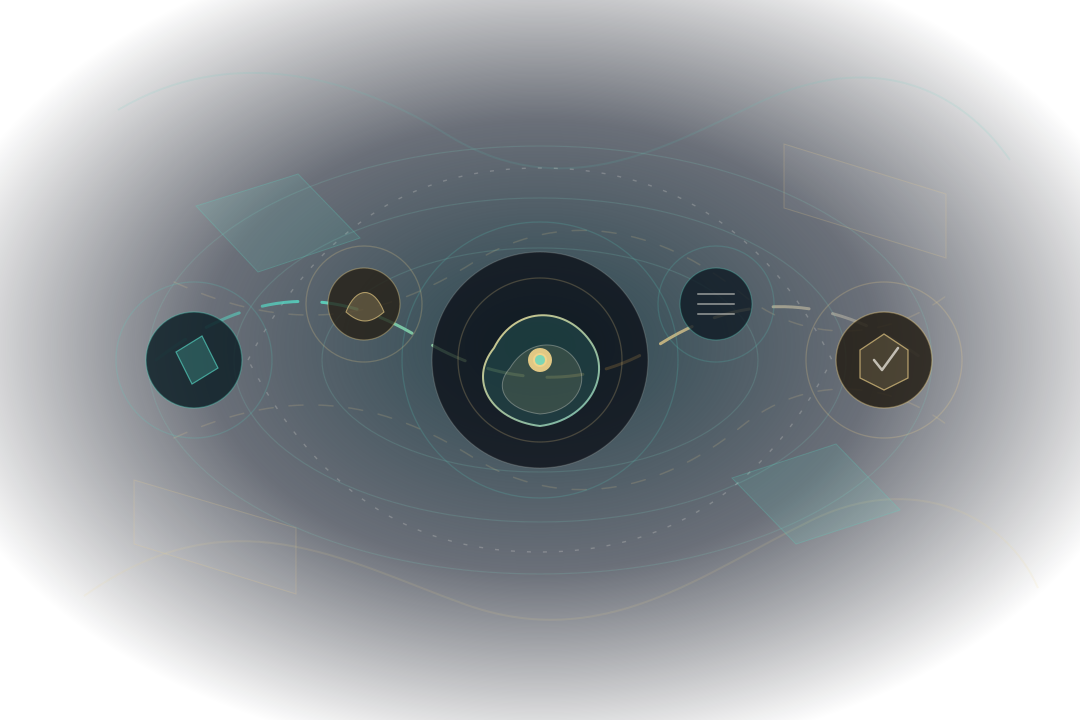
The old promise needed an operating surface.
Unwind Code is not selling another app wrapper. The claim is sharper than that: organisms, not apps. A governed AI organism carries memory, routes work through cells, pauses at authority boundaries, and leaves proof a human can inspect.
That idea cannot wait until a visitor reaches the architecture page. It has to be visible in the first viewport. The new organism-pulse console turns the hero into a live diagram: signal, cortex, memory, proof, and authority. It gives builders, investors, users, subscribers, and collaborators a model they can understand before they click.
A governed hero asset with real product meaning.
The release adds a new textless SVG asset, the Organism Pulse Field, and gives it a semantic console in the homepage hero. The visual stays presentational. The explanation stays inspectable in code-native copy, bilingual translation keys, schema, `llms.txt`, `ai-services.json`, and `asset-manifest.json`.
Textless pulse field
A lightweight SVG shows a request moving through the organism spine without embedding critical UI text inside the image.
Meaning in HTML
The console uses semantic headings, an ordered step list, readable copy, and reduced-motion safeguards.
Manifested purpose
The asset manifest records why the visual exists, what trust value it serves, its performance budget, and its motion policy.
Regression tested
The site test suite now checks the hero console, schema, bilingual copy, metadata, asset safety, and discovery files.
The premium feeling is not allowed to hide the safety posture.
The console names the authority boundary directly: money, files, public posts, and Web3 broadcast stay approval-gated. That line matters because the site is about autonomous systems with real-world edges. The visual language can be cinematic, but the trust model has to stay plain.
For Financial Organisms and on-chain intelligence, this means the interface keeps simulation and review separate from execution. For creative organisms, it means publishing and filesystem changes remain explicit. For self-evolving Brain cells, it means new capability enters through proof, tests, and review rather than vibes.
Every visual should earn its place in the organism.
This release sets the rule for the next layer of UnwindCode.ai: immersive assets are not decoration. They must clarify the architecture, increase trust, help a visitor choose a path, or make a boundary easier to inspect.
The next good visual will probably not be louder. It will be more legible: a clearer product route, a stronger proof surface, a better memory diagram, or a Web3 trust layer that makes "no hidden broadcast path" impossible to miss.
The transmission now leaves a shareable proof packet.
The carousel turns the release into four upload-ready frames for Instagram without turning the architecture into empty spectacle. Each slide carries one proof beat: pulse, organism loop, inspectable meaning, and authority boundary.