 PROTOTYPE / CREATIVE INTELLIGENCE
PERCEPTION / CREATION
Visual Cortex
From an idea to a considered visual direction. Creative intelligence with human judgment at every release.

UNWIND CODE · AI ARCHITECTURE LAB
We design cognitive organisms: living software that perceives, remembers, and evolves under human authority.
THE INFINITY PRINCIPLE
Infinity is not endless motion. It is a system that carries what it learns into what comes next.
The gateway receives a request with context and boundaries. Before motion, there is a question worth understanding.
Working context meets reviewed knowledge and experience. Memory informs the next step without erasing where it came from.
The cortex connects context to a plan. Specialist cells are selected for a bounded purpose, not granted unlimited power.
Immune checks can pause or refuse. Consequential actions require explicit human authority. Learning does not expand permission.
Approved work moves through replaceable specialist cells. Each action stays inside its defined scope and can be inspected.
Results and failures become reviewable records. Tested, approved lessons can inform the next cycle. That is what the infinity means here.
A LIVING ATLAS
A shared anatomy. Different ways of sensing the world. Each organism connects memory, reasoning, and purpose.
PROTOTYPE / CREATIVE INTELLIGENCE
PERCEPTION / CREATION
From an idea to a considered visual direction. Creative intelligence with human judgment at every release.
 PROTOTYPE / PERSONAL INTELLIGENCE
REFLECTION / CONTINUITY
A space to reflect, recognize patterns, and carry context forward. Memory you can understand.
 RESEARCH / SIMULATION
OBSERVATION / JUDGMENT
Market observation and simulation. Evidence guides the analysis; human review precedes consequential action.
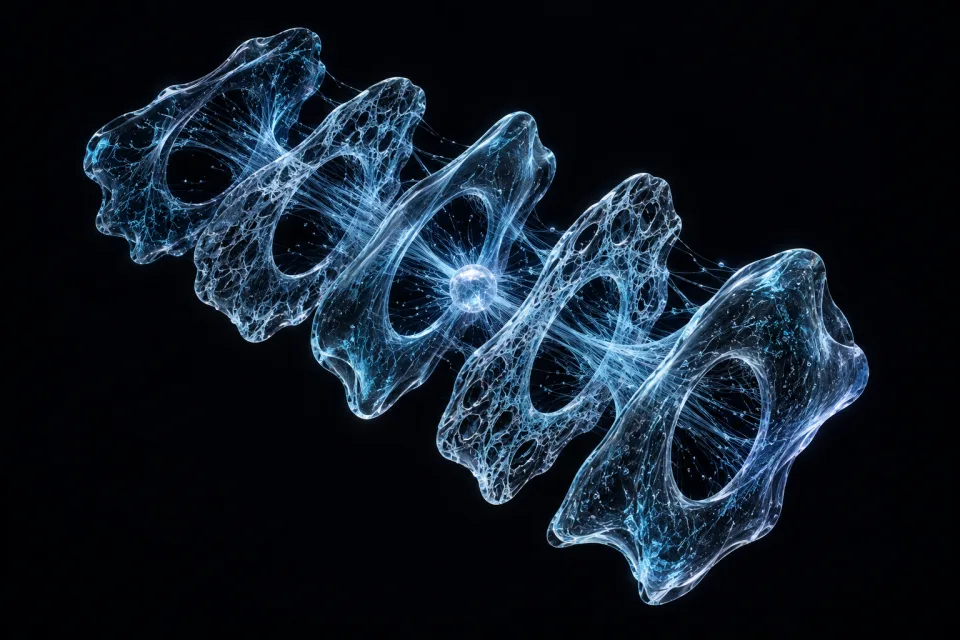 EXPERIMENTAL / COGNITIVE ARCHITECTURE
STRUCTURE / GROWTH
The common anatomy: memory, specialist cells, and a proof loop. A system for building systems.
THE ANATOMY
Each part has a role. Every consequential action returns to the same boundary: human authority.
Reasons, plans, and chooses the next step. Intent becomes a proposed action.
Carries useful context across sessions. Facts, procedures, and experience remain distinguishable.
A defined entry for each request and outward action. Context enters with clear boundaries.
Small, replaceable units that do specialist work. Each cell has a purpose and a scope.
Looks for drift and failures. Contains what needs to stop before it spreads.
Connects work to inspectable records. Evidence makes learning reviewable.
A purpose takes shape. Memory, tools, and boundaries are defined.
Cells work together. Shared context makes the whole useful.
Outcomes become lessons. Changes are reviewed before joining the system.
THE ARCHITECTURE OF RECALL
Four ways of remembering. Together, they connect the present situation with what the organism has learned.
What is happening now: the active task, immediate context, and what needs attention.
How work gets done: methods, playbooks, and procedures that can be repeated and reviewed.
What the system knows: facts, concepts, and relationships organized as knowledge.
What experience has taught it: previous outcomes, historical context, and lessons learned.
03 / THE COMPASS
Increase the clarity. Keep human agency at the heart of every system we build.
Read the doctrineUnderstand the purpose, the context, and the tradeoffs before accelerating a system.
Capability can grow. Permission never grows silently. Consequential actions keep a visible human boundary.
Resources protect attention and decision quality. Financial intelligence begins with observation and simulation, not hidden money movement.
Show the record behind the claim. Keep research, prototypes, verified work, and future ambitions distinguishable.
Build for human dignity, creativity, culture, and care. A more capable system should make room for more humanity.
04 / FROM THE BRAIN
Guides, field notes, and papers from the lab. The architecture, decisions, and lessons that move it forward.
 035
035
What makes a witness independent, and where silent failure can hide.
 034
034
Custody boundaries, relayed authorization, and the decision to stop.
 033
033
From instructions to bounded execution: identity, coordination, and human approval.
05 / FIND YOUR WAY IN
The lab is small on purpose. Every conversation starts with a good question.
Explore the blueprints for memory, cells, and boundaries. Then let's talk about what you want to build.
A vision for governed intelligence, alongside public records to evaluate progress and its limits.
Start with Infinity Mirror: reflection, emotional clarity, and a visible relationship with memory.
Design, research, memory, tools, and creative systems. Let's build from a shared question.
A FEW QUESTIONS
A software system with a cortex that reasons, memory that persists, cells that work, and a proof loop. Its development happens within boundaries defined by people.
Records and architecture notes are in the proof ledger and the transmission archive.
No. Financial actions and outward publications require human approval. These illustrations represent concepts, rather than evidence of live execution.
The failure should be inspectable. Incidents and lessons are recorded so changes can be reviewed and tested.
THE NEXT CHAPTER
We're here to build it. Let's start a conversation.