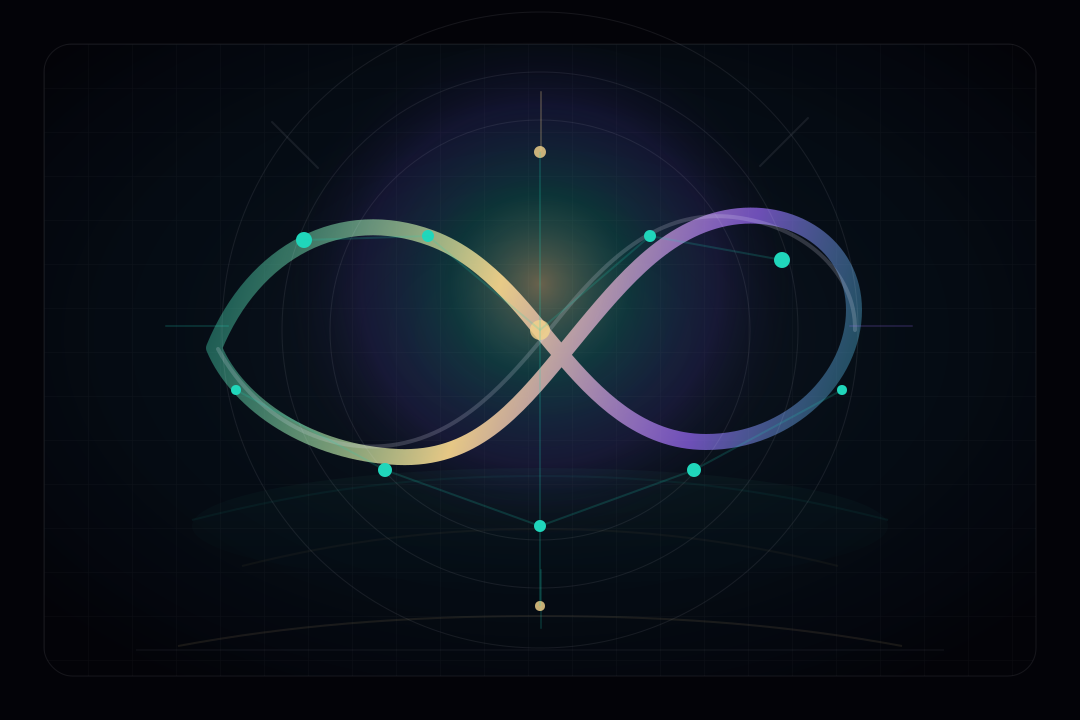
01 / The Mirror

What if software could evolve?

Enter a reflective void where a question becomes memory, memory becomes a cell, cells become an organism, and every new capability must leave proof before it earns authority.

  1. 01Signal

    Question enters.

  2. 02Mirror

    Reflection becomes state.

  3. 03Fracture

    The symbol splits into routes.

  4. 04Cells

    Roles begin to form.

  5. 05Proof

    Evidence returns before authority grows.

  1. 01The Mirror
  2. 02Reflection
  3. 03The Brain
  4. 04Organisms
  5. 05Recursive Growth
  6. 06Proof
  7. 07Join Evolution
Infinite reflection navigation

The infinity symbol becomes the map.

Visitors should not scroll through spectacle hoping to find meaning. The mirror lets them choose a lens, see the proof route, and move through the organism without losing the boundary.

Choose a reflection lens
Reflection lens

Start with the person, not the stack.

The first movement asks what pressure, desire, or uncertainty entered the mirror before any organism proposes a response.

Proof
Desire becomes route, artifact, and boundary.
Boundary
The mirror reflects state; it does not claim identity.
Organism lens

Follow the signal into cells.

The route makes gateway, cortex, memory, immune boundary, specialist cells, and proof feel spatial instead of abstract.

Proof
Every cell has a job, a pause point, and a visible output.
Boundary
Generated capability stays inert until tests and approval.
Trust lens

Let wonder collapse into evidence.

The proof route shows architecture, metrics, deployment records, and status boundaries before asking for trust.

Proof
Claims route to architecture, tests, metadata, and transmissions.
Boundary
If a claim lacks an artifact, the interface says so.
Conversion lens

Exit through the doorway that matches intent.

Builders, investors, researchers, and partners leave with different proof expectations instead of one vague call to action.

Proof
The next step names artifact, boundary, and owner.
Boundary
Collaboration starts with scope, not hidden authority.
  1. 01The Mirror
  2. 02Reflection
  3. 03The Brain
  4. 04Organisms
  5. 05Recursive Growth
  6. 06Proof
  7. 07Join Evolution
Mirror state sequencer

The whole story is a bounded organism loop.

Each chapter names what entered the mirror, which organism response forms, what proof returns, and where authority stops before the next state can open.

Signal
A question enters the reflective threshold.
Organism response
Gateway listens before any cell claims work.
Proof return
The threshold readout names signal, boundary, and proof.
Boundary lock
No authority grows before evidence is visible.
Open Mirror chapter
02 / Reflection

The mirror is where apps stop and organisms begin.

A static app waits for commands. An AI organism carries memory, routes work through cells, pauses at risk boundaries, and shows what changed. The interface has to make that difference visible.

Traditional software

Executes the flow.

It resets context, hides decisions inside screens, and asks the user to manage the meaning around the tool.

AI organism

Learns through proof.

It remembers state, chooses specialist cells, keeps authority bounded, and leaves evidence a human can inspect.

  1. 01Command enters

    A request arrives as state, not a button press to forget.

  2. 02Context wakes

    Memory gives continuity while uncertainty stays visible.

  3. 03Authority is bounded

    Identity, money, files, and public motion remain human-led.

  4. 04Proof returns

    The answer comes back with assumptions, limits, and evidence.

Human signal atlas The organism starts with what people want AI to make possible.

The research pattern is not one desire. People ask AI for mental room, better work, access to skills, personal growth, economic security, and world repair. The mirror turns each ask into a route, a proof artifact, and a boundary.

Research source: Anthropic 81K Interviews
  1. Mental roomMake room for life.

    The ask is less burden, more attention, and a calmer next step.

    Route
    Infinity Mirror + memory boundary
    Proof
    Returned artifact, no hidden authority
  2. Better workRaise capability without erasing agency.

    The ask is mastery, speed, and relief from repetitive cognitive load.

    Route
    Brain cells + Visual Cortex
    Proof
    Production packet and testable route
  3. Technical accessLet people build what used to be out of reach.

    The ask is translation between imagination, tools, and a working artifact.

    Route
    Cortex, sandbox, candidate cells
    Proof
    Sandbox result before capability joins
  4. BecomingSupport growth without claiming identity.

    The ask is reflection, learning, healing, and a patient place to think.

    Route
    Reflection cell + source-aware memory
    Proof
    Care boundary and user correction path
  5. SecurityTurn financial pressure into clearer decisions.

    The ask is economic stability without handing the system hidden power.

    Route
    Financial organism + unsigned review
    Proof
    Simulation first, no keys, no broadcast
  6. World repairKeep big hope attached to evidence.

    The ask is research, healthcare, education, and public-good intelligence that does not inflate claims.

    Route
    Research organisms + proof ledger
    Proof
    Source, method, caveat, status
81K desire translation Human desire becomes an organism route only when proof can answer it.

Anthropic's study is not copied as a quote wall. Unwind translates the research categories into routeable signals: what the person wants, which organism responds, what proof must return, and where authority stops.

Source pattern: Anthropic 81K Interviews
  1. 18.8% / Professional excellenceBetter work asks for visible leverage.

    Routine load should become strategic room, not another hidden dashboard.

    Organism route
    Brain cells + Visual Cortex
    Proof gate
    Before/after artifact, owner approval, and no hidden labor claim.
    Authority stop
    The organism can support mastery; it cannot decide the person's value.
  2. 13.7% / Personal transformationGrowth needs a reversible mirror.

    The mirror can help someone name a pattern without turning it into identity authority.

    Organism route
    Infinity Mirror + Reflection cell
    Proof gate
    Returned artifact, correction path, care boundary.
    Authority stop
    No diagnosis, destiny, or unreviewed memory.
  3. 13.5% / Life managementMental load needs a calmer loop.

    Logistics become useful only when they return attention to the human.

    Organism route
    Memory boundary + Ritualist lens
    Proof gate
    Task packet, consented reminders, visible memory edits.
    Authority stop
    No hidden scheduling authority or private inference.
  4. 11.1% / Time freedomTime saved has to be felt.

    Speed matters when it gives back presence, rest, or family time.

    Organism route
    Automation cell + Proof ledger
    Proof gate
    Time-return artifact and human acceptance check.
    Authority stop
    Automation cannot quietly choose priorities.
  5. 9.7% / Financial independenceSecurity starts as simulation.

    Economic pressure needs review packets before value can move.

    Organism route
    Financial organism
    Proof gate
    Unsigned simulation, risk flags, no-key boundary.
    Authority stop
    No keys, no broadcast, no financial authority.
  6. 9.4% / Societal transformationBig hope needs small evidence.

    Public-good ambition is strongest when claims stay sourced and caveated.

    Organism route
    Research organisms
    Proof gate
    Source, method, limitation, status.
    Authority stop
    No inflated impact claim without evidence.
  7. 8.7% / EntrepreneurshipBuilders need a path from idea to artifact.

    Access should lower the distance between imagination, code, and proof.

    Organism route
    Cortex + sandbox + build packet
    Proof gate
    Sandbox result, implementation packet, release gate.
    Authority stop
    Generated capability stays inert until tests pass.
  8. 8.4% / Learning and growthLearning wants patient translation.

    The organism should make complex material inspectable without embarrassment.

    Organism route
    Translator lens + Research cell
    Proof gate
    Source-backed explanation, unknowns, next question.
    Authority stop
    It teaches with caveats; it does not pretend certainty.
  9. 5.6% / Creative expressionImagination needs production memory.

    Creative intent becomes a storyboard, asset rule, and reviewable output.

    Organism route
    Visual Cortex
    Proof gate
    Production packet, brand memory, publish approval.
    Authority stop
    No public posting or asset spend without approval.
Mirror route compass The mirror chooses a chapter only after the signal earns a route.

The 81K signal becomes useful when a visitor can see where their desire enters the story, what proof comes back, and which authority boundary stays closed.

  1. 01 / Mental roomEnter through The Mirror.

    The person needs quiet, not a claim.

    Chapter
    The Mirror + Reflection
    Proof return
    A reviewed question, a boundary, and one human-owned next move.
    Authority stop
    No diagnosis, identity label, or hidden memory.
    Open the threshold
  2. 02 / MasteryRoute through The Brain.

    The person wants better work without becoming managed by the tool.

    Chapter
    The Brain
    Proof return
    Cell route, test gate, owner decision, and before/after artifact.
    Authority stop
    No generated capability executes outside review.
    Trace the cells
  3. 03 / AccessMove toward Join Evolution.

    The person needs a bridge from imagination to a working first slice.

    Chapter
    Join Evolution
    Proof return
    First artifact packet, sandbox plan, and approval boundary.
    Authority stop
    No build starts until scope and owner are explicit.
    Choose first artifact
  4. 04 / BecomingDescend through Recursive Growth.

    The person wants transformation without being pinned to a fixed identity.

    Chapter
    Reflection + Recursive Growth
    Proof return
    Correctable pattern, memory choice, and next-loop proof lock.
    Authority stop
    Growth never becomes destiny, diagnosis, or unreviewed memory.
    Inspect growth gates
  5. 05 / SecurityPass through Proof first.

    The person wants economic clarity without handing the system value motion.

    Chapter
    Proof + Financial Organism
    Proof return
    Unsigned simulation, risk note, and no-key boundary.
    Authority stop
    No wallet control, swap, broadcast, or money motion.
    Open proof route
  6. 06 / World repairSplit into Organisms.

    The person wants public-good intelligence with claims that can survive inspection.

    Chapter
    Organisms + Proof
    Proof return
    Source, method, caveat, status, and stewardship path.
    Authority stop
    No impact claim outruns evidence.
    See organisms split

The compass is a semantic routing map. It does not infer identity, store a preference, submit data, call a model, start a build, move money, deploy, post, or grant autonomy.

Delivery calibration Aspiration becomes trustworthy only when the mirror can show what actually changed.

The 81K signal shows AI already delivering in productivity, cognitive partnership, learning, technical access, research synthesis, and emotional support, while a real share of people say it has not delivered. Unwind turns that gap into proof gates.

  1. ProductivitySpeed must return time, not just output.

    The route names what burden changed, what artifact proves it, and what still needs a human decision.

    Gate: before/after artifact plus owner approval.
  2. Cognitive partnershipA thinking partner needs visible assumptions.

    The organism can reason with a person, but every claim must surface source, caveat, and confidence.

    Gate: reasoning trace and correction path.
  3. AccessNew capability enters through sandbox.

    If AI helps someone build what was out of reach, Unwind still tests the cell before it joins the organism.

    Gate: sandbox result before integration.
  4. SupportPatience is useful only with care boundaries.

    Availability and no judgment can help reflection, but the mirror cannot become diagnosis, identity, or care authority.

    Gate: human-led next step and care disclaimer.
  5. Not deliveredFailure is a first-class signal.

    When AI falls short, the organism must say what is missing, what remains manual, and what proof would change status.

    Gate: status label, unknowns, and next evidence.
Signal constellation The mirror starts with voices, not features.

Every role enters with a hope and a boundary. The organism becomes trustworthy only when those signals are routed to a cell, a proof path, and a visible pause point.

  1. BuilderMake evolution inspectable.

    Needs a system that can grow new cells without hiding writes, tools, or approvals.

    Route: cortex, sandbox, proof.
  2. UserReflect without deciding identity.

    Needs memory that reduces burden while care, consent, and next action stay human-led.

    Route: state, reflection, boundary.
  3. InvestorSeparate signal from spectacle.

    Needs evidence of what exists, what is simulated, and what still waits for proof.

    Route: status, metrics, transmissions.
  4. ResearcherTrace claim to source.

    Needs unknowns kept alive until evidence, method, and limits are clear.

    Route: source, method, caveat.
Adaptive mirror engine One reflection can be read four ways.

A serious mirror does not force every person through the same frame. It can translate a signal as structure, map, language, or ritual while keeping the final choice human-led.

Capture
One honest signal
Translate
Lens chosen with uncertainty visible
Keep
Artifact and map update stay reviewable
Signal composer Choose the signal and watch the mirror return a bounded packet.

The visitor does not need to trust an invisible model. A selected signal changes the lens, the returned artifact, and the proof boundary in view.

Choose a human signal
Selected signal
Mental room request
Lens returned
Translator + Ritualist
Artifact promise
One calmer question, one grounded next action, and no hidden memory update.
Boundary
No diagnosis, no identity claim, no forced growth label.
Remix fit analysis The design concepts graduate only when they make trust easier to inspect.

The local engine package contributes a persistent shell, archetype lenses, listening valve, artifact return, growth phases, and descent motion. The website keeps each idea only with an owner, a proof surface, and an authority boundary.

  1. Persistent shellOne mirror surface survives every screen.

    Use the same reflective object across talk, capture, map, ritual, and proof so continuity is visible.

    Boundary: continuity does not imply hidden memory.
  2. Overridable lensPersonalization must be reversible.

    Architect, Cartographer, Translator, and Ritualist are useful render modes, not identity labels.

    Boundary: no birth-date destiny; the human can change the frame.
  3. Listening valveQuiet listening is a valid product path.

    The mirror can hold a session without tagging, mapping, or converting everything into growth work.

    Boundary: no artifact, no claim, no pressure.
  4. Artifact returnOutput has to become holdable.

    A useful run returns signal, lens, map, boundary, proof path, and decisions the person still owns.

    Boundary: keep, correct, deepen, or close loop.
  5. Growth phasesEvolution is a status, not a rank.

    Seed, root, bloom, and transcendence become visible phase states for capability maturity.

    Boundary: tests and approvals decide the phase.
  6. Descent engineImmersion must come back out.

    The recursive tunnel is strongest when it exits with route, boundary, and evidence.

    Boundary: every spectacle returns proof.
Persistent shell specimen The mirror should feel like one instrument that keeps returning proof.

The Remix package's mobile language becomes an Unwind-native specimen: one stable mirror, a growth-state meter, a prompt chamber, an artifact return, and a bottom route shell that never hides authority.

Local proof shell Reflection mode
Mirror core Continuity without hidden memory.

The shell remains stable while every state explains what changed and what stayed human-led.

Growth stage
  1. Seed
  2. Reflection
  3. Pattern
  4. Proof
Prompt chamber Let the signal slow down.

The interface can offer a gentle prompt, a pattern question, or a future-self question without forcing a claim.

Returned artifact
Signal
Continuity request
Boundary
Review before memory
Choice
Keep, correct, deepen, close
  1. 01 / ConstantOne surface, many states.

    The visitor always knows they are inside the same organism, even as the route changes.

  2. 02 / PhaseGrowth is maturity evidence.

    Seed, reflection, pattern, and proof are capability states backed by tests and review.

  3. 03 / QuestionPrompts reduce pressure.

    The mirror asks clearer questions before it generates stronger claims.

  4. 04 / ReviewArtifact before acceptance.

    Nothing becomes memory, proof, or public motion until the returned object can be inspected.

Engine distillation The mirror keeps one shell while the output becomes proof.

The design concept is strongest when the interface treats reflection as a loop, not a chat reply: listen, translate, map, return an artifact, then let the person keep, refuse, deepen, or turn it into one grounded action.

  1. 01Talk or capture

    A raw signal can enter as text, voice, or quiet listening without forcing a label.

  2. 02Lens translates

    Architect, Cartographer, Translator, or Ritualist frames the same signal without taking final authority.

  3. 03Map remembers

    Recurrence becomes topography, constellation, river, or garden only after the user accepts the meaning.

  4. 04Artifact returns

    The mirror returns pattern, belief, reframe, question, and ritual as a reviewable object.

Pressure-release valve

Some sessions should only listen. No tagging, no artifact, no growth claim. Refusal is part of the interface because consent is part of the architecture.

  • Keep
  • Refuse
  • Deepen
  • Ritual
Returned artifact specimen The mirror gives back a reviewable object, not a mood.

A reflection run should leave a packet that names the signal, lens, memory map, authority boundary, proof path, and the choices a person still owns.

signal_in
I need continuity without hidden authority.
lens
Architect + Cartographer
memory_map
Context, recurrence, friction, next safe move.
boundary_lock
Care, identity, money, files, and public motion stay human-led.
proof_path
Assumptions, route, status, and evidence are named.
  • Keep
  • Correct
  • Deepen
  • Close loop
Repair ledger A crack becomes a question before it becomes memory.
  1. 01

    Name the assumption that broke.

  2. 02

    Ask the human to keep, correct, or close.

  3. 03

    Store only the reviewed artifact.

  1. 01Capture signal
  2. 02Choose lens
  3. 03Map recurrence
  4. 04Lock boundary
  5. 05Return proof
Descent protocol Immersion earns trust only when the descent returns proof.

The engine concept's scroll journey becomes a governed route: self, memory, split, lattice, current, evolution, and return. Each stage has a product job and an authority boundary.

  1. 01Self enters

    The visitor sees the request as state, not as a command vanishing into a prompt.

  2. 02Memory appears

    Continuity becomes visible while the mirror keeps uncertainty and consent in view.

  3. 03Decision splits

    Possible routes branch before any one lens pretends to be final.

  4. 04Lattice connects

    Cells, memories, and proof paths connect into a map the human can inspect.

  5. 05Current moves

    The organism can recommend the next move, but risky execution stays outside the automatic current.

  6. 06Evolution proposes

    New capability remains a candidate until sandbox, review, and approval make it real.

  7. 07Proof returns

    The loop exits with a route, a boundary, and an artifact the visitor can question.

03 / The Brain

The Brain is not a metaphor when cells have jobs.

Each cell has a bounded role. The visitor should be able to see the system route a signal without pretending the whole organism is magic.

Inspect brain cell architecture
Recursive brain tunnel Move through the route a signal takes.

The tunnel turns scroll into organism grammar: signal dives inward, cells wake, boundaries hold, and proof returns outward.

  1. 01Signal dives

    A visitor question enters as context instead of vanishing into a prompt box.

  2. 02Cells wake

    Gateway, cortex, memory, immune, and proof roles light in sequence.

  3. 03Boundary holds

    Identity, money, files, publishing, and Web3 motion remain outside the automatic path.

  4. 04Proof resurfaces

    The route exits with assumptions, limits, status, and the next artifact.

Gateway

Receives the signal and names the channel.

Cortex

Chooses the path and keeps reasoning bounded.

Memory

Carries continuity without becoming authority.

Reflection

Turns state into a useful mirror read.

Pattern

Finds recurrence without declaring destiny.

Immune

Pauses risk, requests approval, and refuses unsafe motion.

Proof

Leaves the artifact that makes trust inspectable.

05 / Recursive growth

Self-evolution only earns meaning when the loop is inspectable.

The organism can propose a new capability, but it must pass through research, sandbox, immune review, approval, integration, and public proof before the visitor is asked to believe it.

  1. 01Pattern repeats

    The system sees a repeated need or failure.

  2. 02Candidate cell

    A new specialist is drafted as a bounded proposal.

  3. 03Sandbox trial

    The cell proves behavior before joining the organism.

  4. 04Authority gate

    Risky motion pauses for human approval.

  5. 05Integrated cell

    Only the verified capability joins the organism as a replaceable cell.

  6. 06Proof artifact

    The change leaves a record visitors can inspect.

The loop may propose evolution. Tests, approval, integration notes, and public proof decide whether it becomes part of the organism.

05B / Cognitive evolution trace

A living intelligence is a loop you can inspect.

The mirror should not jump from spectacle to proof. It should show the metabolism: signal becomes memory, cells take roles, proof returns, and the next loop opens only when the boundary is clear.

  1. 01 Signal enters
    Evolves
    A human question becomes typed context.
    Proof lock
    The route names what is known, unknown, and refused.
  2. 02 Memory reflects
    Evolves
    Relevant history returns as a map, not a hidden identity.
    Proof lock
    The human can correct, refuse, or close the memory path.
  3. 03 Cells specialize
    Evolves
    Gateway, Cortex, Memory, Immune, and Proof cells split the work.
    Proof lock
    Each cell has one job and one authority stop.
  4. 04 Capability is tested
    Evolves
    A new cell remains a candidate until sandbox proof exists.
    Proof lock
    No file write, spend, deploy, or broadcast can skip approval.
  5. 05 Proof returns
    Evolves
    The output becomes a reviewable artifact with evidence.
    Proof lock
    A claim without an artifact cannot become capability.
  6. 06 Next loop opens
    Evolves
    Only reviewed proof can become the next organism signal.
    Proof lock
    The human decides whether the loop grows, pauses, or ends.
06 / Proof

The mirror cannot be trusted unless the boundary is visible.

The premium feeling is not gloss. It is legibility: architecture, metrics, deployments, status labels, schema, and tests all saying what the system can and cannot do.

Floating architecture maps A living interface earns trust by showing the route a signal takes.
  1. 01 Gateway intake

    Names the visitor signal before the organism chooses cells or tools.

  2. 02 Cortex route

    Selects context, memory, and specialist cells for the next safe move.

  3. 03 Memory boundary

    Carries continuity without letting past state become hidden authority.

  4. 04 Immune gate

    Pauses money, files, public posting, Web3 broadcast, and risky execution.

  5. 05 Proof loop

    Returns architecture, tests, status, and transmissions to the surface.

Phase proof ledger Seven phases now resolve into evidence, surface, and boundary.

The experience is allowed to feel immersive only because every phase has a visible proof job: what changed, where a visitor can inspect it, and where authority stops.

  1. 01 / Reverse engineering Source patterns become audit lenses.
    Evidence
    Experience audit and source translation ledger.
    Boundary
    Translate structure; do not clone the source skin.
  2. 02 / Concept The infinity mark becomes a bounded loop.
    Evidence
    Portal, threshold, reflection navigator, and state sequencer.
    Boundary
    The symbol explains route and authority, not decoration.
  3. 03 / Story arc Seven chapters carry one proof loop.
    Evidence
    Mirror, Reflection, Brain, Organisms, Growth, Proof, and Join anchors.
    Boundary
    No chapter asks for trust without returning proof.
  4. 04 / Motion Cinematic motion earns a contract.
    Evidence
    Scroll map, emotional rail, motion contract, and runtime handoff.
    Boundary
    CSS and SVG ship first; heavier runtimes stay gated.
  5. 05 / Visual exploration Assets clarify architecture.
    Evidence
    Portal, tunnel, organism visualizer, maps, and infinity doorway.
    Boundary
    No visual exists only to decorate; it must explain a route.
  6. 06 / Implementation The future runtime is a packet, not a surprise.
    Evidence
    Implementation packet, code handoff, source kit, and asset manifest.
    Boundary
    React, Framer, GSAP, Three, and Tailwind wait for migration approval.
  7. 07 / Execution The build must leave proof before public motion.
    Evidence
    Tests, build output, browser smoke, release notes, and deployment approval.
    Boundary
    Deployments, posting, and aliases remain explicit human checkpoints.
Scroll choreography map The visitor descends through seven proof-bearing acts.

This is the cinematic score behind the page: each scroll beat changes focus, reveals a motion layer, and returns the visitor to an inspectable proof surface.

  1. Act 01 Question enters the void.
    Focus
    The infinity portal and threshold proof readout.
    Motion
    Fracture sequence, depth rings, bounded canvas pulse.
    Proof return
    Signal, boundary, and proof labels appear before awe.
  2. Act 02 Software becomes a comparison.
    Focus
    Traditional software versus AI organisms.
    Motion
    Reflection plane routes input through memory, boundary, proof.
    Proof return
    Every claim returns as assumptions, limits, and evidence.
  3. Act 03 The loop finds cells.
    Focus
    Recursive tunnel, brain network, route console.
    Motion
    Signal pulse selects gateway, cortex, memory, immune, proof.
    Proof return
    The system names which cell can act and which must pause.
  4. Act 04 Cells become product paths.
    Focus
    Visual Cortex, Infinity Mirror, Financial, Research organisms.
    Motion
    Governed spine and organism orbit relay wake in sequence.
    Proof return
    Each organism exposes route, boundary, and next artifact.
  5. Act 05 The organism earns density.
    Focus
    Six-gate recursive growth loop.
    Motion
    Pattern, candidate, sandbox, approval, integration, proof expand.
    Proof return
    Growth is visible only after tests, approval, and status.
  6. Act 06 Wonder becomes inspection.
    Focus
    Architecture maps, motion contract, audit, source ledger.
    Motion
    Floating panes settle into claim, evidence, boundary, artifact.
    Proof return
    Discovery files, schemas, tests, and ledgers carry the claims.
  7. Act 07 The doorway opens by role.
    Focus
    Builders, investors, researchers, partners.
    Motion
    Infinity symbol language and role-specific doorway cards.
    Proof return
    The next action is concrete and authority-bounded.
Emotional progression rail The experience moves feeling into proof before it asks for trust.

Anthropic's page works because wonder, unease, and responsibility stay together. Infinity Mirror makes that journey explicit: every feeling becomes an organism route, a proof return, and an authority boundary.

Choose the emotional beat
Visitor feeling
Curiosity opens the system without demanding belief.
Organism route
The portal holds attention while the proof threshold names signal, boundary, and evidence.
Proof return
The first viewport shows the claim, the route, and the inspection path together.
Authority boundary
Wonder cannot outrun evidence.
Motion contract Every cinematic move has a proof job.

The experience can feel alive only when each motion explains the organism: what triggered it, what changed, how long it runs, and how it stays lightweight.

  1. 01 / Portal Fracture reveals routing.
    Trigger
    First viewport scroll depth.
    Animation
    Infinity scale, reflection plane, shard split, cell wake.
    Timing
    Scrubbed depth map, CSS ease, 5-step sequence.
    Duration
    Five scroll states; each visible state resolves inside 1.2s.
    Easing
    Scrubbed linear depth with cubic-bezier(0.16, 1, 0.3, 1) entrance easing.
    Performance
    Transform and opacity only; static reduced-motion state.
  2. 02 / Reflection Plane turns command into proof.
    Trigger
    Reflection section enters the viewport.
    Animation
    Current lines pass through input, memory, boundary, proof.
    Timing
    5.8s loop with calm cubic easing.
    Duration
    640ms reveal, then a 5.8s ambient current loop.
    Easing
    Cubic-bezier(0.16, 1, 0.3, 1) for reveal, ease-in-out for the current.
    Performance
    No layout animation; semantic steps carry the meaning.
  3. 03 / Signal Human roles stay readable.
    Trigger
    Role constellation appears after tension copy.
    Animation
    Builder, user, investor, researcher nodes pulse around one loop.
    Timing
    6.8s current, 5.8s node pulse.
    Duration
    720ms section reveal, persistent 5.8s node cycle.
    Easing
    Ease-in-out pulse; entrance uses cubic-bezier(0.16, 1, 0.3, 1).
    Performance
    Visual-only constellation; route packets remain plain HTML.
  4. 04 / Human signal Research becomes calibrated route choices.
    Trigger
    Human Signal Atlas and delivery calibration enter after the tension thread.
    Animation
    Desire nodes and delivery pulses calibrate the Infinity core while route cards stay readable.
    Timing
    11s atlas scan, 12.4s delivery scan, 5.8s node pulse, no forced scroll pin.
    Duration
    800ms card reveal with 11s and 12.4s background scans.
    Easing
    Slow ease-in-out scan; route cards use the mirror cubic easing.
    Performance
    CSS transform and opacity only; source link, proof gates, and route text stay semantic.
  5. 05 / Product Facets and concept fit explain the engine.
    Trigger
    Remix fit matrix and product loop reach reading position.
    Animation
    Fit nodes and talk, capture, map, ritual facets orbit stable shells.
    Timing
    12s concept-fit scan and 12s product sheen.
    Duration
    900ms shell reveal, 12s scans, no blocking timeline.
    Easing
    Cubic-bezier(0.16, 1, 0.3, 1) for reveal; linear sheen drift.
    Performance
    No JS dependency; concept decisions and artifact decisions stay inspectable as text.
  6. 06 / Descent Immersion returns as proof.
    Trigger
    Descent protocol appears after the returned artifact.
    Animation
    Self, memory, split, lattice, current, evolution, and return stages receive a soft scan.
    Timing
    12s field scan, 7.6s meter, 9.2s stage current.
    Duration
    960ms section reveal, then 12s field scan.
    Easing
    Cinematic cubic reveal; ambient loops use ease-in-out.
    Performance
    No canvas import; the zip engine is translated into HTML, CSS, and reduced-motion-safe stages.
  7. 07 / Brain Tunnel makes routing spatial.
    Trigger
    Brain chapter follows the reflection engine.
    Animation
    Nested rings, signal axis, gateway, cortex, memory, immune, proof.
    Timing
    9s scan with staggered cell pulses.
    Duration
    1.1s tunnel reveal, 9s scan, 120ms cell stagger.
    Easing
    Depth reveal uses cubic-bezier(0.16, 1, 0.3, 1); pulses stay ease-in-out.
    Performance
    CSS/SVG first; Three.js remains optional desktop enhancement.
  8. 08 / Proof Wonder stabilizes into ledger.
    Trigger
    Proof chapter replaces awe with inspection.
    Animation
    Claim, evidence, boundary, artifact route draws across cards.
    Timing
    7.4s route draw, 5.8s node pulse.
    Duration
    740ms ledger reveal, 7.4s route draw.
    Easing
    Route draw stays linear; ledger reveal uses the mirror cubic easing.
    Performance
    Real links and labels remain usable without animation.
  9. 09 / Doorway Conversion keeps role boundaries.
    Trigger
    Join chapter reaches the final reading position.
    Animation
    Infinity breathes while builder, investor, researcher, and partner nodes stay route-specific.
    Timing
    12s orbit, 8s Infinity pulse, 6.4s doorway node cadence.
    Duration
    800ms route reveal, 12s orbit, 8s symbol pulse.
    Easing
    Route reveal uses cubic-bezier(0.16, 1, 0.3, 1); orbit loops ease-in-out.
    Performance
    Links are real anchors; visual orbit is decorative and can freeze without losing meaning.
Experience audit console The pattern is inspected before it becomes an Unwind interface.

Phase 1 stays visible: the reference is decomposed into ten design lenses, then reinterpreted as proof-bound organism behavior instead of copied surface style.

Open full experience audit
  1. 01 / Information architectureScale needs a readable spine.
    Purpose
    Move from human signal to method, findings, proof, and implications without losing orientation.
    Why it works
    The visitor always knows whether they are in story, evidence, or decision space.
    Unwind reinterpretation
    The mirror uses chapters, rails, proof routes, and visible authority gates as its spine.
  2. 02 / Storytelling flowEmotion enters before abstraction.
    Purpose
    Let individual tension make large research feel human before systems appear.
    Why it works
    Hope and alarm stay together, so the experience feels honest instead of promotional.
    Unwind reinterpretation
    The route begins with reflection, then reveals brain cells, organisms, proof, and choices.
  3. 03 / Scroll choreographyScroll controls attention, not spectacle.
    Purpose
    Stage one idea at a time while a persistent visual field keeps continuity.
    Why it works
    The page slows the reader at the exact moments where meaning changes.
    Unwind reinterpretation
    Infinity fractures into reflection, cell routing, organism orbit, and proof return.
  4. 04 / Motion systemMotion must name state.
    Purpose
    Use movement to show progression, comparison, and focus rather than decorate the viewport.
    Why it works
    Small loops make the system feel alive while preserving reading order.
    Unwind reinterpretation
    Every motion lane gets a trigger, duration, easing, fallback, and stop condition.
  5. 05 / Visual hierarchyAwe needs inspection nearby.
    Purpose
    Balance immersive moments with compact labels, evidence, and route controls.
    Why it works
    Large visuals open curiosity; nearby proof keeps the reader grounded.
    Unwind reinterpretation
    The portal is always paired with proof cards, ledgers, and next-path anchors.
  6. 06 / Typography systemVoice separates wonder from proof.
    Purpose
    Use type hierarchy to separate thesis, evidence, labels, and caveats.
    Why it works
    Readers can scan the emotional claim and still inspect the machinery.
    Unwind reinterpretation
    Human language carries the thesis; mono labels carry state, gates, and proof.
  7. 07 / Transition logicEach chapter changes the visitor's job.
    Purpose
    Shift from feeling to comparison, then architecture, then proof, then action.
    Why it works
    The reader is never asked to judge the whole thesis at once.
    Unwind reinterpretation
    Every transition asks a narrower question: what changed, what acts, what proves it.
  8. 08 / Attention managementChoice appears after orientation.
    Purpose
    Delay heavy interaction until the visitor understands the frame.
    Why it works
    The page earns attention before it asks for exploration or conversion.
    Unwind reinterpretation
    Role routes, lens buttons, and proof doors appear only after the mirror explains itself.
  9. 09 / Emotional progressionWonder must land as trust.
    Purpose
    Move from curiosity to recognition, tension, agency, and grounded next action.
    Why it works
    The ending feels earned because the experience has admitted limits along the way.
    Unwind reinterpretation
    The mirror can feel alive, but every living claim returns with boundary and proof.
  10. 10 / Performance techniqueThe cinematic layer stays cheap.
    Purpose
    Keep the page fluid while preserving semantic fallback and accessibility.
    Why it works
    SVG, CSS, restrained JavaScript, and reduced-motion support protect comprehension.
    Unwind reinterpretation
    Canvas, Framer, GSAP, and Three stay optional leaf layers behind explicit gates.
Source translation ledger The research pattern was translated into organism proof, not copied as a design skin.

The 81K page gives the design law: human signal first, method visible, emotion and proof held together. Infinity Mirror converts those laws into architecture, motion, and approval gates.

Source pattern: Anthropic 81K Interviews
  1. 01 / Scale Scale becomes responsibility.
    Source pattern
    80,508 participants across 159 countries and 70 languages.
    Unwind translation
    The mirror starts with human signal before cells, systems, or visual spectacle.
    Boundary
    No fake persona, fake quote, or invented user story.
  2. 02 / Method Method stays visible.
    Source pattern
    AI interviewer, classifiers, de-identified responses, manual quote review, and stated limitations.
    Unwind translation
    Unwind exposes source links, proof gates, status labels, and assumptions.
    Boundary
    Inference is labeled as translation, not research ownership.
  3. 03 / Tension Hope and alarm stay together.
    Source pattern
    The study frames AI hope and AI alarm as coexisting tensions.
    Unwind translation
    Capability, memory, and autonomy are presented with authority gates.
    Boundary
    No all-good or all-bad AI claim.
  4. 04 / Delivery Delivery gaps become gates.
    Source pattern
    Productivity led at 32.0%, while 18.9% said AI has not delivered.
    Unwind translation
    The route turns delivery claims into proof gates and unknowns.
    Boundary
    A claim can remain incomplete until evidence changes status.
  5. 05 / Choreography Scroll becomes attention discipline.
    Source pattern
    Sticky staged focus, narrative slides, quote relief, and chart exploration.
    Unwind translation
    Infinity Mirror uses portal, fracture, descent, brain route, proof ledger, and doorway.
    Boundary
    Motion must explain architecture.
  6. 06 / Non-clone The boundary stays explicit.
    Source pattern
    Do not reuse the cream editorial world, globe, quote wall, or category-chart skin.
    Unwind translation
    Use black reflective void, Infinity symbol, organism spine, cells, and approval locks.
    Boundary
    The symbol means loop plus boundary, never decoration.
Engine translation The remix engine becomes a governed state machine, not an uncontrolled canvas.

The uploaded package's strongest idea is one living field that responds to progress, pointer energy, lens, artifact return, and proof. The website translates that into inspectable states before any React, camera, or canvas runtime is allowed to own meaning.

Source
Local zip: experience/mirror-engine.js
Runtime now
Semantic HTML, CSS, SVG, reduced-motion guard
Upgrade path
React leaf plus optional isolated canvas after proof
Blocked by default
Camera, DOB authority, hidden memory, mobile always-on canvas
  1. ProgressScroll becomes named stage.

    Tunnel, neural web, figure, network, and return become semantic chapters instead of hidden canvas weights.

  2. Pointer energyInteraction can deepen, not decide.

    Cursor energy may enrich a desktop portal later, but no claim or route can depend on it.

  3. LensPersonalization stays reversible.

    Architect, Cartographer, Translator, and Ritualist remain presentation modes the human can change.

  4. ArtifactA session must leave something inspectable.

    Signal, lens, memory map, boundary, proof path, and decisions close the loop.

  5. ApprovalRisk waits outside the automatic current.

    Files, money, public posting, Web3 broadcast, care claims, and deploys stay human-led.

  1. Adopt nowState grammar.

    Persistent shell, reversible lenses, artifact decisions, pressure valve, and proof-returning descent.

  2. Prototype nextIsolated motion runtime.

    Canvas light field, kintsugi/gaze fallback, pointer response, and vertical social scenes as leaf modules.

  3. Block until proofAuthority-sensitive features.

    DOB identity truth, default camera access, hidden memory maps, and continuous mobile canvas.

Concept analysis packet The ZIP becomes product grammar, not production authority.

The package contributes a persistent mirror shell, reversible lenses, a just-talk pressure valve, returned artifacts, signal maps, kintsugi growth, and 9:16 social scenes. Each concept is sorted into adopt now, prototype next, or block until proof.

Open engine concept analysis
  1. AdoptShell, lenses, valve, artifact.

    These ideas make the product path easier to understand and the proof loop easier to inspect.

  2. PrototypeDescent, kintsugi, map, social scenes.

    These can deepen the experience once they have fallbacks, cleanup, consent, and local verification.

  3. BlockIdentity, camera, hidden memory.

    These remain outside the public route until consent, proof, and authority boundaries are explicit.

Implementation ledger The interface should prove how it would ship before it asks anyone to believe the vision.

Phase 6 and 7 become a visible operating model: semantic shell first, motion as isolated islands, optional 3D behind a fallback, metadata synced, and release blocked until approval.

  1. Semantic shellMeaning ships in HTML before motion.

    Headings, route links, bilingual strings, schema, and proof text remain readable without JavaScript.

    Artifact
    Static route, i18n keys, ImageObject schema
    Boundary
    No critical text hidden in SVG, canvas, or WebGL.
  2. Motion islandsAnimation stays isolated and low cost.

    CSS/SVG carries the first version; future Framer or GSAP islands must own cleanup and avoid layout animation.

    Artifact
    Motion contract, reduced-motion state, rAF scroll update
    Boundary
    Transform and opacity only for continuous motion.
  3. 3D gateThree.js is an enhancement, not the source of truth.

    Recursive tunnel and WebGL distortion wait until the static route proves the story and fallback.

    Artifact
    Optional desktop module plus SVG fallback
    Boundary
    Pause offscreen, cap DPR, disable on mobile.
  4. Evidence syncDiscovery files must match the page.

    Asset manifest, llms.txt, ai-services.json, sitemap, and tests update when the public route changes.

    Artifact
    Tests, manifests, sitemap, AI service contract
    Boundary
    No claim survives without a discoverable proof path.
  5. Release gateLocal proof comes before public motion.

    The route can be reviewed locally, packaged as a transmission, and paired with social assets before any deploy.

    Artifact
    Local render, build output, transmission packet
    Boundary
    Deploy only after explicit approval.
Builder execution packet The next build should be four isolated engines, not one tangled spectacle.

The implementation path turns the experience into production contracts a builder can pick up: semantic React shell, Framer motion island, optional GSAP/Three tunnel, and governed asset/release packet.

Open implementation packet
  1. 01 / React shellServer-rendered meaning first.

    `InfinityMirrorExperience.tsx` owns chapters, schema, route links, bilingual copy, and proof data before any client motion hydrates.

    Ships
    Typed chapter data, semantic sections, ImageObject schema
    Gate
    No critical claim depends on JavaScript.
  2. 02 / Framer islandCards move without owning scroll.

    `MirrorChapterMotion.client.tsx` handles reveals, lens swaps, and route-card microinteractions with transform, opacity, and cleanup.

    Motion
    Viewport reveal, staggered cells, tactile route states
    Gate
    No layout animation, no global scroll listener.
  3. 03 / Tunnel gateGSAP and Three.js stay optional.

    `MirrorPortalTimeline.client.tsx` and `MirrorBrainTunnel.client.tsx` can deepen the portal only on desktop, after static proof passes.

    Motion
    Pinned portal, instanced lemniscate particles, pause offscreen
    Gate
    Reduced motion and mobile receive the SVG route.
  4. 04 / Release packetAssets, metadata, tests, and social proof move together.

    Every public change updates the SVG fallback, asset manifest, `llms.txt`, `ai-services.json`, route tests, build output, and optional IG carousel.

    Ships
    Asset spec, discovery sync, local render, carousel packet
    Gate
    Public deployment waits for explicit approval.
Runtime handoff matrix Each motion engine gets one job, one fallback, and one stop condition.

The cinematic system becomes production-ready only when CSS, Framer, GSAP, and Three/WebGL are assigned to isolated lanes with explicit triggers, durations, easing, fallbacks, and performance gates.

  1. 01 / CSS + SVG The current route owns meaning.
    Owns
    Portal pulse, story rail, proof cards, fallback graphics
    Trigger
    Page load, viewport entry, hash navigation
    Motion
    Opacity, transform, SVG line draw, calm ambient scan
    Timing
    240ms to 1.2s reveals; 5.8s to 13s ambient loops
    Fallback
    Reduced motion freezes to semantic sections
  2. 02 / Framer leaf Microinteractions stay local.
    Owns
    Lens swaps, card reveals, route hover states, artifact focus
    Trigger
    Viewport once, pointer hover, selected lens change
    Motion
    Spring opacity and transform, no layout ownership
    Timing
    0.24s quick, 0.64s medium, spring stiffness 100 damping 20
    Fallback
    Static cards remain fully readable and clickable
  3. 03 / GSAP portal Scroll theater stays contained.
    Owns
    Pinned portal timeline, fracture depth, tunnel chapter scrub
    Trigger
    Desktop viewport, proof-ready static route, reduced motion off
    Motion
    ScrollTrigger scrub with transform-only state changes
    Timing
    5 to 7 viewport story span, cubic entrance easing
    Fallback
    Anchor chapters and CSS fracture sequence remain canonical
  4. 04 / Three + WebGL Depth is enhancement, never authority.
    Owns
    Recursive brain tunnel, lemniscate particles, reflective shader field
    Trigger
    Desktop capable device, visible canvas, user motion allowed
    Motion
    Instanced particles and shader distortion tied to a bounded scene clock
    Timing
    60fps target, DPR capped at 1.5, pause when offscreen
    Fallback
    SVG tunnel and semantic route steps carry the story

Runtime rule: if an engine cannot name its fallback, cleanup, and stop condition, it does not enter the organism.

Depth readiness gate The mirror becomes cinematic only when the fallback is already true.

Depth is a privilege layer. CSS, Framer, GSAP, and Three/WebGL can deepen the portal only after semantic meaning, proof routes, mobile behavior, and shutdown rules are visible.

  1. 01 / Semantic depth Ship the readable mirror first.
    Trigger
    Page load, hash route, reduced-motion visit.
    Allowed
    HTML, bilingual text, SVG fallback, bounded canvas field.
    Proof needed
    Headings, anchors, schema, tests, and no critical text in visuals.
    Fallback
    The full route remains meaningful without JavaScript.
    Kill switch
    Freeze ambient loops under reduced motion or compact screens.
  2. 02 / Framer depth Let cards breathe after meaning exists.
    Trigger
    Viewport entry, lens selection, route-card hover.
    Allowed
    Opacity, transform, spring reveal, local selected-state only.
    Proof needed
    Static cards, keyboard focus, reduced-motion branch, no network calls.
    Fallback
    Server-rendered cards stay visible and clickable.
    Kill switch
    Do not own scroll, layout meaning, storage, deploy, or posting.
  3. 03 / GSAP depth Pin theater only on capable desktop.
    Trigger
    Desktop viewport, reduced motion off, semantic route already passed.
    Allowed
    Pinned portal fracture, scrubbed depth, transform-only chapter staging.
    Proof needed
    Anchor navigation, cleanup with context revert, no mobile scroll hijack.
    Fallback
    CSS fracture sequence and chapter anchors remain canonical.
    Kill switch
    Skip below 900px, when reduced motion is true, or when cleanup fails.
  4. 04 / Three + WebGL depth Depth cannot become authority.
    Trigger
    Desktop-capable GPU, visible canvas, user motion allowed.
    Allowed
    Decorative recursive tunnel, particles, shader field, DPR cap.
    Proof needed
    SVG tunnel fallback, pause offscreen, dispose geometry/materials/renderer.
    Fallback
    RecursiveBrainTunnel and BrainRouteConsole carry all meaning.
    Kill switch
    Disable under 900px, cap DPR at 1.5, cancel frames offscreen.

Depth gate rule: if the cinematic layer cannot be removed without changing the claim, the claim is not ready for production.

Runtime code handoff Phase 7 now leaves implementation-ready files without changing the current stack.

The current route stays dependency-free. The handoff gives the future React/Next build exact leaf files, cleanup rules, fallbacks, Tailwind tokens, and asset contracts for the cinematic migration.

Open runtime code handoff Open runtime kit
  1. 01 / React pageServer component owns meaning.

    `page.tsx` renders metadata, headings, chapters, proof links, and static fallbacks before any client leaf hydrates.

    File
    app/organisms/infinity-mirror/experience/page.tsx
    Guard
    No browser APIs, no generated copy, no risky side effects.
  2. 02 / Framer leafMotion reveals what already exists.

    `MirrorChapterMotion.client.tsx` handles viewport reveal, selected lens state, and tactile route cards with reduced-motion fallback.

    File
    components/mirror/MirrorChapterMotion.client.tsx
    Guard
    Transform and opacity only; no scroll ownership.
  3. 03 / GSAP portalPinned theater stays optional.

    `MirrorPortalTimeline.client.tsx` owns only desktop portal fracture choreography with `gsap.context` cleanup.

    File
    components/mirror/MirrorPortalTimeline.client.tsx
    Guard
    Skip reduced motion and compact screens; current anchors remain canonical.
  4. 04 / Three gateWebGL deepens depth, never authority.

    `MirrorBrainTunnelGate.client.tsx` creates the optional desktop tunnel, pauses offscreen, caps DPR, and disposes every object.

    File
    components/mirror/MirrorBrainTunnelGate.client.tsx
    Guard
    Semantic brain tunnel remains the fallback and source of meaning.
  5. 05 / Tailwind tokensThe visual language becomes portable.

    `tailwind.config.ts` preserves void, reflection, proof, boundary, organism, 8px radius, and mirror easing.

    File
    tailwind.config.ts
    Guard
    Avoid one-note AI gradients; mobile collapses to one column.
  6. 06 / Asset contractEvery visual has a proof job.

    `infinityMirrorAssets.ts` names SVG, packet, code handoff, social preview, manifest, discovery, and release rules.

    File
    lib/mirror/infinityMirrorAssets.ts
    Guard
    No critical text in visuals; deploy only after approval.
Proof observatory Architecture, metrics, deployments, and status become one inspectable instrument.

The Proof chapter should feel like a control room without pretending it is live telemetry. Each lane names the evidence path, current signal, authority boundary, and next artifact a visitor can inspect.

Choose an evidence lane
Evidence path
Architecture proves how a signal moves through Gateway, Cortex, Memory, Cells, Immune Gate, and Proof Loop.
Current signal
The stack is inspectable as route, not mystique.
Authority boundary
Architecture explains capability; it does not grant autonomy.
Authority gradient The mirror earns permission one gate at a time.

A living interface should never jump from reflection to action. Each rung names what the system may do, what proof must exist, and what remains human-owned.

  1. 01 / Observe Observe signal
    Can do
    Read the visible request and page context.
    Proof required
    No memory is written and no hidden state is claimed.
  2. 02 / Reflect Reflect meaning
    Can do
    Return assumptions, tensions, and possible routes.
    Proof required
    Language stays inspectable, reversible, and correction-ready.
  3. 03 / Draft Draft artifact
    Can do
    Shape a plan, component, memo, packet, or prototype path.
    Proof required
    Output is reviewable before it changes anything.
  4. 04 / Sandbox Sandbox capability
    Can do
    Test generated code or cell behavior in isolation.
    Proof required
    Logs, failures, and rollback path return before trust grows.
  5. 05 / Approval Request approval
    Can do
    Ask before filesystem, spend, deploy, post, or Web3 motion.
    Proof required
    The human sees the exact action, cost, surface, and boundary.
  6. 06 / Public motion Move publicly
    Can do
    Ship, alias, broadcast, or post only after explicit approval.
    Proof required
    Public motion leaves metadata, release notes, and a proof trail.

No rung grants hidden memory, identity authority, wallet control, public posting, deployment, or status changes by itself.

07 / Join Evolution

Choose the doorway that matches your reason for entering.

Builders, investors, researchers, and partners need different proof paths. The mirror should guide each one toward the next artifact, not the same generic CTA.

Mirror engine language The symbol means loop plus boundary.

The remix engine treats the mirror as one persistent surface. On UnwindCode.ai, the infinity mark now has seven public states: each one must name what loops, what proves it, and where authority stops.

  1. 01Portal

    The first signal crosses only when the threshold names evidence and boundary.

  2. 02Reflection

    Raw want returns as lens, memory map, proof path, and human-owned choice.

  3. 03Brain route

    Cortex, memory, gateway, immune, and proof cells explain what can act.

  4. 04Organism orbit

    Visual Cortex, Mirror, Financial, and Research organisms share one governed spine.

  5. 05Earned density

    The core grows only through pattern, sandbox, approval, integration, and proof.

  6. 06Proof return

    Beauty answers to architecture, metrics, status, tests, and transmissions.

  7. 07Bounded doorway

    Builders, investors, researchers, and partners choose a concrete next route.

First artifact router The next step is a packet someone can inspect.

Each visitor leaves with a bounded artifact path: what to bring, what Unwind returns first, where proof lives, and what still needs explicit approval.

  1. 01 / Builder Prototype organism
    Bring
    Domain friction, data shape, owner, and one risk boundary.
    First artifact
    Architecture packet plus sandboxed first-slice plan.
    Proof route
    Component tree, cell map, test gate, and rollback note.
    Approval boundary
    No generated capability executes outside review.
    Open architecture map
  2. 02 / Investor Diligence packet
    Bring
    Thesis, risk questions, proof threshold, and timeline horizon.
    First artifact
    Proof memo separating shipped surfaces from future claims.
    Proof route
    Proof ledger, transmissions, status labels, and metadata.
    Approval boundary
    No financial promise or production claim outruns evidence.
    Open proof register
  3. 03 / Researcher Source map
    Bring
    Research question, method concern, and desired comparison.
    First artifact
    Source translation map with assumptions, caveats, and next experiment.
    Proof route
    Experience audit, source ledger, and roadmap status.
    Approval boundary
    No research claim becomes public certainty without review.
    Open vision observatory
  4. 04 / Partner Collaboration packet
    Bring
    Domain, success condition, constraints, budget boundary, and proof appetite.
    First artifact
    First-sprint scope with owner, risk stops, and review cadence.
    Proof route
    Collaboration packet, authority map, and first milestone artifact.
    Approval boundary
    No deploy, spend, public post, or Web3 motion without explicit approval.
    Start build conversation

The router does not submit data, create a lead, start a build, spend money, deploy, post publicly, or grant autonomy. It only makes the first inspectable artifact legible.

Entry protocol Joining is a proof loop, not a form.

A builder, investor, researcher, or partner should know what happens after the doorway. The first move is small, inspectable, and bounded before the organism earns more authority.

  1. 01 / Signal Bring the real friction.
    Input
    Role, domain, current constraint, and why the loop matters now.
    Proof output
    A typed request that can be routed to cells, proof, or refusal.
  2. 02 / Boundary Name what must not move.
    Input
    Files, money, public posting, Web3 broadcast, identity, and care limits.
    Proof output
    A visible authority map before any build or diligence work starts.
  3. 03 / First proof Produce one reviewable artifact.
    Input
    Architecture packet, prototype, diligence memo, source map, or sprint note.
    Proof output
    An artifact someone can inspect before a larger promise is made.
  4. 04 / Next loop Choose grow, pause, deepen, or close.
    Input
    Human review of the artifact, risks, cost, and evidence quality.
    Proof output
    A next action with the same boundary still visible.