Bring a serious system. Leave with an organism path.
Unwind Code works with builders, investors, protocols, creators, and operators who need more than a prompt demo. We map the organism, identify the authority boundary, design the proof loop, and decide what should act, what should wait, and what must stay human.
Different visitors need different proof.
Start with the lane that matches your intent. Each path points to the clearest artifact before a conversation asks for trust.
Builders
Map a workflow into cortex, memory, gateway, tools, safety gates, and testable integration points.
Study the organism stack Proof pathInvestors
Evaluate the thesis through public artifacts, status labels, transmissions, and bounded Web3 posture.
Inspect proof first Prototype pathUsers
Join early access for human-facing systems like Infinity Mirror as they move from prototype to product.
Explore Infinity Mirror Simulation pathProtocols
Design a Web3 simulation lane with read-only research, risk scoring, unsigned review packets, and no hidden wallet authority.
View Web3 boundaries Conversation pathCollaborators
Bring a problem domain, an authority boundary, and a proof requirement. The lab turns it into an organism path.
Start the conversationA serious inquiry becomes a bounded packet before it becomes work.
The lab does not start by selling hours. It turns your signal into a role lens, authority boundary, proof requirement, organism route, and first sprint packet so the next step is concrete.
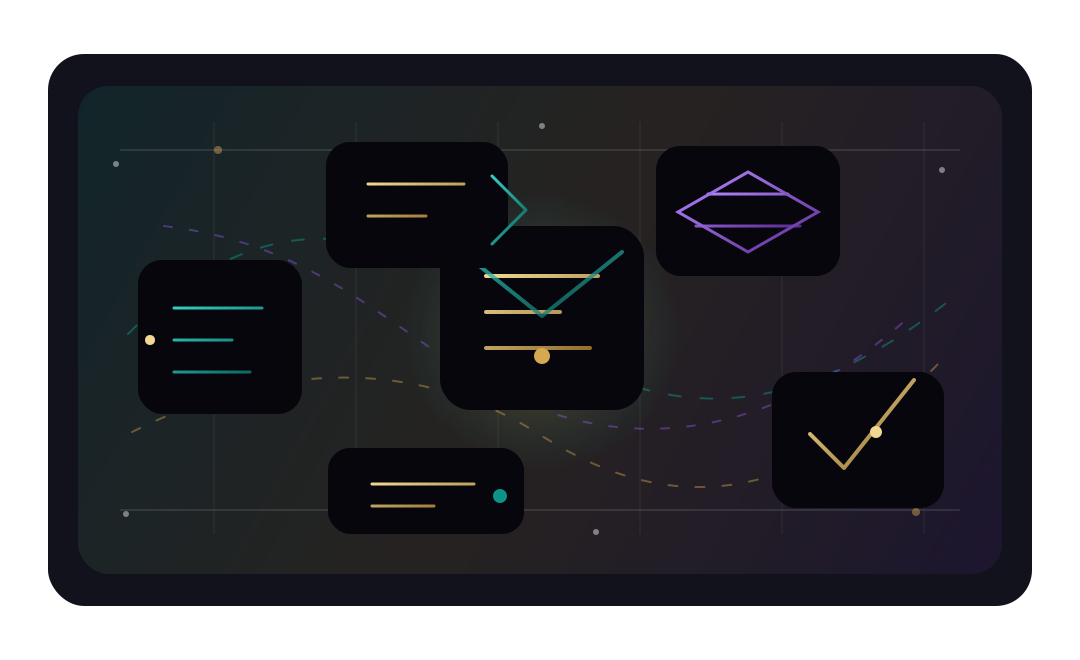
01Visitor signal
A builder, investor, protocol, user, creator, or collaborator brings a real domain and a reason to care.
02Role lens
The page routes the visitor toward the artifact that matches their trust question before asking for a conversation.
03Authority boundary
Filesystem writes, public posting, money movement, wallet authority, and generated code are named before a prototype gets tools.
04Proof requirement
The packet records what evidence would make the system trustworthy: tests, review notes, transmissions, metrics, or release artifacts.
05Organism route
The work becomes an architecture review, prototype organism, Web3 simulation lane, proof-loop audit, or product organism path.
06First sprint packet
Only after the goal, boundary, and proof bar are explicit does the lab propose a small, inspectable first sprint.
What to send first.
A useful collaboration starts with the shape of the organism, not a vague feature request. Send the minimum context that lets the lab map action, risk, and proof.
AI organism architecture collaboration
- 01
The outcome you want the organism to create.
- 02
The domain, users, channels, and tools it needs to understand.
- 03
The authority boundary it must never cross without approval.
- 04
The evidence you would need before trusting it.
Choose the smallest useful engagement.
Every collaboration starts with a mode, a deliverable, a proof bar, and an authority boundary. Pick the path that matches the risk you need to make legible first.
Send the first signal