AI + Web3 Architecture Lab

What if your systems could
think for themselves?

We don't write code that runs and stops. We design AI organisms — living cognitive systems that perceive, decide, and evolve under proof. From creative intelligence to simulation-first Web3 organisms, this is where AI meets human authority.

5 Organism paths
32 Public transmissions
0 Hidden authority paths

Start with the question you came here to answer.

Unwind Code can look abstract from the outside. Choose the door that matches your intent and the lab will take you to the clearest next artifact.
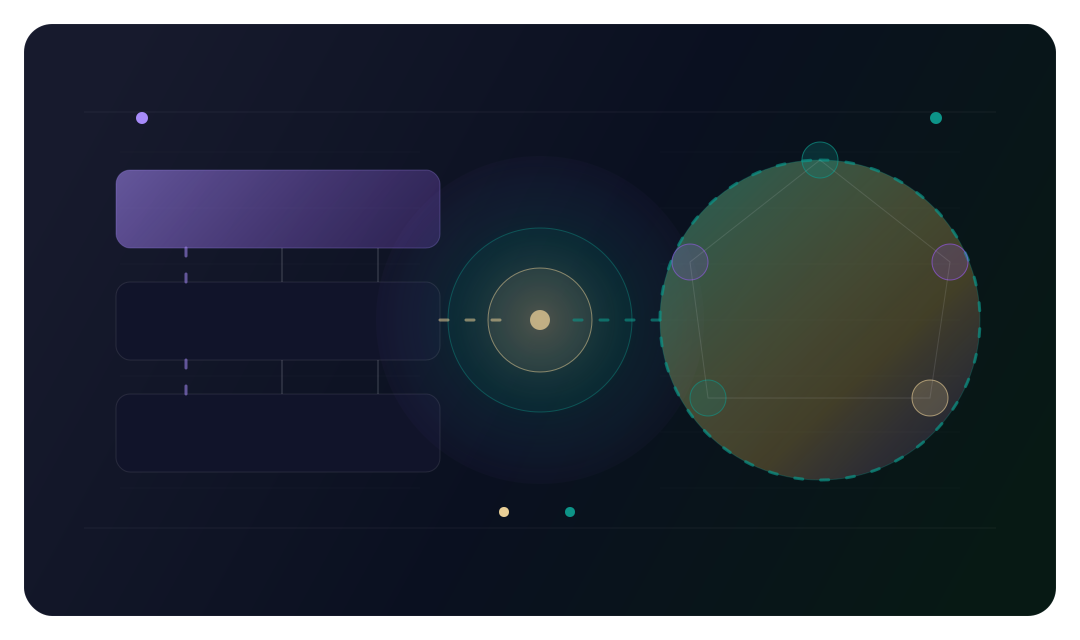
Unwind organism spine Cortex, memory, cells, immune gates, proof
Architecture
Proof
Product paths
Choose the evidence path that matches your intent.
Architecture + cell growth

Start with the organism stack and Brain Cell Architecture.

Map the domain into cortex, memory, gateway, cells, immune gates, and proof before a prototype receives tools or autonomy.

Inspect
Operating model, cognitive-flow map, and cell growth protocol.
Boundary
Generated capability stays inert until tests, sandbox, approval, and source control pass.
Study the stack
Visual Cortex

Turn creative intent into reviewable production plans.

Visual Cortex coordinates brand, tone, design, and sales cells so a creator workflow becomes evidence, not another prompt demo.

Inspect
Creator intelligence path, specialist cells, and human-approved output boundary.
Boundary
Publishing, spending, and filesystem writes pause for approval.
Explore Visual Cortex
Infinity Mirror

See the personal evolution organism as a usable mirror.

Infinity Mirror is the human-facing path: state capture, pattern continuity, reflection, and a grounded next action.

Inspect
Prototype thesis, product form, and early-access path.
Boundary
Reflection supports judgment; it does not replace care, identity, or human authority.
Explore Infinity Mirror
Financial Organisms

Review on-chain intelligence before money can move.

Financial Organisms are framed as research and simulation: read-only context, risk scoring, unsigned review packets, and no hidden broadcast path.

Inspect
Simulation lane, Monad Hand, SEC Gate, and no-broadcast posture.
Boundary
No private keys, no live money motion, and no transaction authority by default.
Inspect Web3 boundaries
Proof ledger

Evaluate what exists before trusting the vision.

The proof ledger gathers status labels, transmissions, safety gates, and architecture artifacts so the organism story can be inspected.

Inspect
Whitepaper, proof register, public artifacts, and bounded Web3 posture.
Boundary
Claims stay tied to artifacts, explicit unknowns, and maturity labels.
Open the proof ledger
Collaboration gateway

Bring a domain where the boundary matters.

The lab starts by naming the goal, authority limit, proof requirement, and safest first organism path.

Inspect
Architecture review, prototype organism, proof-loop audit, or Web3 simulation lane.
Boundary
The first engagement defines what should act, what should wait, and what must stay human.
Build with us

An organism is a system that carries state forward.

Unwind Code builds governed cognitive systems, not static software wrappers. Each organism has a cortex for reasoning, memory for continuity, gateways for communication, specialized cells for work, immune boundaries for risk, and a proof loop humans can inspect.

Study the architecture

Core anatomy

  • 01Cortex
  • 02Memory
  • 03Gateway
  • 04Cells
  • 05Immune System
  • 06Proof Loop
Difference lens From task execution to governed continuity.
Inspect why an organism is not just another app.
Continuity layer

An app finishes a task. An organism remembers what the run taught it.

The important difference is not personality. It is controlled continuity: working context, durable memory, and proof stay separated so the next run improves without becoming unbounded.

Typical app
Returns output, closes the loop, and loses the reason it chose that path.
AI organism
Stores bounded memory, debriefs the run, and keeps evidence attached to what changes.
Cortex routing

An organism routes intent through the right cells before it acts.

Instead of one prompt doing everything, the cortex chooses context, specialist cells, tools, risk posture, and the proof artifact the visitor should inspect.

Typical app
Runs a fixed workflow or model call, then presents the answer.
AI organism
Routes through cortex, memory, gateway, cells, immune gates, and proof output.
Human authority

Authority is named before capability gets tools.

The lab treats money, files, public posts, outreach, and Web3 broadcast as gates. More intelligence should create clearer approvals, not hidden side effects.

Typical app
Can turn a click into side effects the visitor cannot inspect first.
AI organism
Stops at approval boundaries and leaves the exact reason for the pause.
Public evidence

Trust comes from what the organism leaves behind.

Every serious claim should connect to architecture, tests, transmissions, status labels, source boundaries, or a release packet a human can review.

Typical app
Asks users to trust the interface or the outcome.
AI organism
Attaches outputs to proof loops, safety gates, and inspectable public artifacts.
Organisms versus apps
Dimension Typical app AI organism
State Waits for input, completes a task, and often resets context. Carries memory forward so each session can refine the next decision.
Reasoning Runs a predetermined flow or model call. Routes work through cortex, cells, tools, and review gates.
Authority Can hide side effects behind product actions. Pauses at money, filesystem, public-posting, and high-risk gates.
Proof Reports outcomes after the fact. Leaves architecture notes, status labels, tests, and transmissions.
Evolution Improves only when a team ships another release. Can propose new tested cells while humans keep activation authority.

One organism spine. Five product paths. Proof around every edge.

The ecosystem is not a pile of apps. Cortex, memory, gateway, immune boundaries, and proof loop form the shared spine; each public organism is a specialist path with its own status and authority boundary.

Explore the organism ecosystem
Memory
Carries state forward between runs.
Immune boundary
Pauses money, files, public posts, and risky execution.
Proof loop
Turns claims into transmissions, tests, and reviewable artifacts.

Organisms, Not Apps

Most software is built to be used. Ours is built to be alive. Each organism is a self-contained intelligence — it observes, reasons, acts, and remembers. Some are product prototypes. Some simulate Web3 boundaries. All of them get safer when proof is visible.

Visual Cortex

Prototype Human-approved output

You have a brand story to tell. Four AI agents — Brand Analyst, Tone Expert, Design Specialist, and Sales Optimizer — collaborate to transform your raw script into a broadcast-ready video blueprint. In minutes, not weeks.

Infinity Mirror

Prototype Personal reflection only

Your personal evolution engine. A self-reflecting app that audits where you are, maps where you want to go, and generates new growth strategies — creating an infinite loop of becoming the person you intend to be.

Financial Organisms

Research No live money motion

A Web3 research lane that interprets risk, simulates routes, and prepares unsigned review packets before any money motion. The boundary is the product: no private keys, no hidden wallet path, no broadcast by default.

Brain Cell Architecture

Experimental Sandboxed cell growth

The blueprint behind every organism. A proprietary 6-phase methodology for designing new AI minds — complete with memory systems, decision frameworks, and knowledge structures. This is the brain that builds brains.

Research Organisms

Research Source-bound claims

A source-bound research lane for turning AI patterns, backend behavior, Web3 signals, product questions, and cultural intelligence into caveated maps, experiments, and publication-ready proof.

What can be inspected today?

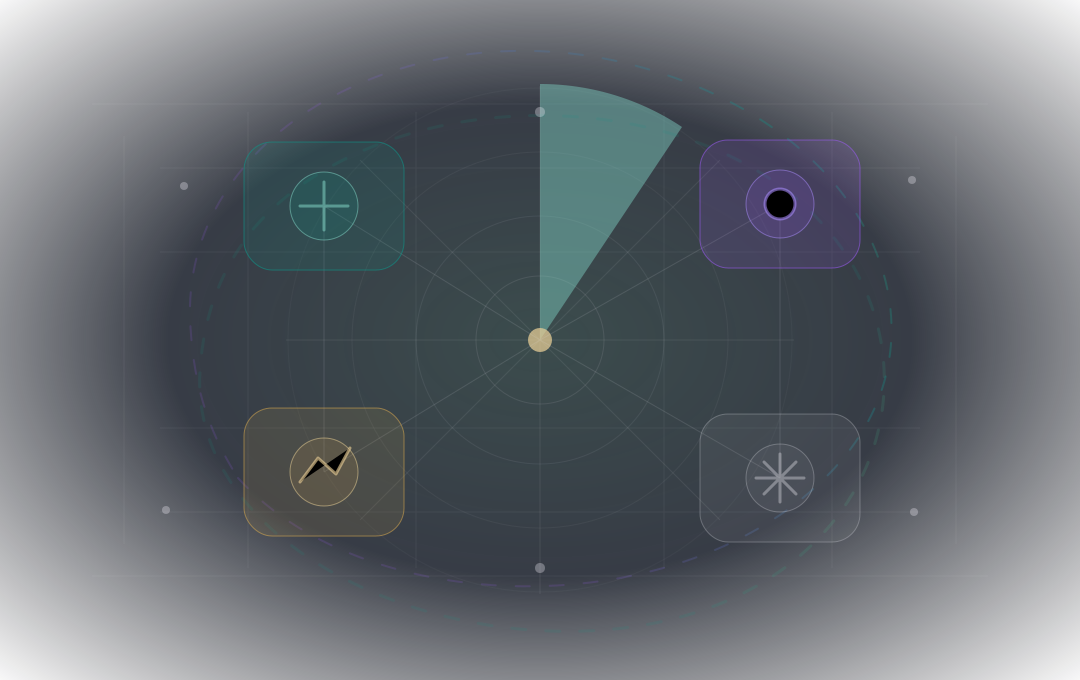
Each organism path carries a different maturity state, proof trail, authority boundary, and next action. The radar makes that visible before a visitor chooses where to go.

Open the proof ledger
Inspect organism readiness by path
Prototype

Creator intelligence is ready to inspect as a governed production packet.

Proof artifact
Pipeline map and production packet console show brand memory, specialist cells, proof bar, and human review.
Authority boundary
Publishing, spend, files, and distribution stay human-approved.
Prototype

The human-facing mirror path is prototype-stage and evidence-backed.

Proof artifact
Reflection loop, session console, and Transmission 24 make product form inspectable.
Authority boundary
The mirror reflects and suggests; it does not replace care, identity, consent, or professional support.
Research

Web3 intelligence stays simulation-first until authority is explicit.

Proof artifact
Trust-layer map, simulation console, and safety transmissions expose the no-broadcast posture.
Authority boundary
No private keys, no hidden wallet path, no live money motion, and no broadcast by default.
Experimental

Brain Cell Architecture is the governed path for growing new capability.

Proof artifact
Lifecycle map, runtime console, and checkpoint whitepaper show sandbox, review, approval, and rollback.
Authority boundary
Generated cells stay inert until tests, source control, sandbox evidence, and human review pass.
Research

Research Organisms turn unknowns into source-bound proof paths.

Proof artifact
Capability ledger and research field map preserve source packets, question maps, experiments, caveats, and publication gates.
Authority boundary
Speculation stays labeled, sources stay visible, and public claims wait for human review.

How We Give Machines a Mind

Every organism we build follows a three-layer cognitive architecture — inspired by how biological brains actually develop. From birth, to connection, to continuous adaptation.

01
Neurogenesis

Birth

Every mind starts with a blank page. Through six rigorous phases — research, architecture, memory design, protocols, knowledge integration, and delivery — a new cognitive agent emerges, purpose-built for its domain.

02
Synaptic Formation

Connection

Isolated intelligence is limited. Through shared memory, orchestrated communication, and a central coordinator, individual agents form a living network — each one making the others stronger.

03
Neural Plasticity

Evolution

Every session teaches the organism something new. Every debrief preserves institutional knowledge. Every interaction strengthens the neural pathway. The more you use it, the smarter it gets.

A request only earns action after it survives the loop.

The homepage promise becomes credible when the stack is inspectable: gateway intake, bounded context, specialist cells, immune decisions, and proof output all appear before autonomy receives authority.

  1. 01 Gateway signal

    The organism receives a human goal, channel, role, and risk shape.

  2. 02 Context fence

    Memory is recalled, bounded, and separated from authority.

  3. 03 Specialist cells

    The cortex routes work to the smallest capable cell path.

  4. 04 Immune decision

    Money, files, public posts, and Web3 broadcast pause for approval.

  5. 05 Proof output

    The run leaves tests, artifacts, status labels, or a transmission trail.

Open the full architecture map

Every movement has to explain the organism.

Animation is treated as instrumentation. It can show signal, focus, boundary, proof, or shutdown; it cannot carry meaning that disappears for crawlers, screen readers, reduced motion, or compact screens.

  1. 01 / Signal Pulse means work entered the system.
    Allowed motion
    Canvas particles, SVG pulses, and route highlights that mirror gateway, cortex, memory, proof, and boundary nodes.
    Proof return
    The same sequence is written in semantic HTML beside the visual field.
  2. 02 / Focus Reveal means the next proof beat is ready.
    Allowed motion
    Opacity and transform-only reveals that preserve reading order and hash targets.
    Proof return
    The content is already present in the document before the reveal runs.
  3. 03 / Boundary Locks mean authority stopped on purpose.
    Allowed motion
    Small state changes that clarify approval gates for files, money, publishing, Web3 broadcast, and generated capability.
    Proof return
    Each lock names what is blocked and which proof route can inspect it.
  4. 04 / Shutdown Reduced motion is a first-class route.
    Allowed motion
    Static fallbacks, frozen loops, no scroll hijack, no WebGL requirement, and no motion-only proof.
    Proof return
    Meaning remains in text, schema, tests, metadata, and durable route links.

Four-Tier Memory Architecture

Working Memory Current situation, active tasks, volatile attention buffer
Procedural Memory How-to knowledge, playbooks, condition-action rules
Semantic Memory Domain facts, frameworks, knowledge graphs
Episodic Memory Historical cases, lessons learned, case-based reasoning

The organism exposes its state before it asks for trust.

A premium AI lab should not hide behind a cinematic surface. This console names what is live, what is prototype, what remains research, and which proof route keeps authority bounded.

Open the proof ledger
  1. 01 / Intake Visitor signal enters a bounded route.

    Home, pathfinder, and Brain starter prompts clarify the request before work begins.

  2. 02 / Memory Public artifacts carry context.

    Transmissions, specs, llms.txt, sitemap, and ai-services.json preserve what the lab can prove.

  3. 03 / Boundary Authority stays labeled.

    Money, files, posting, private data, generated cells, and Web3 broadcast pause for approval.

  4. 04 / Proof Every serious claim points to evidence.

    Routes return architecture, status, tests, release packets, or explicit unknowns.

Live

Public organism routes

Five organism paths are published with state labels, proof artifacts, and route-specific authority limits.

Proof
Organism index, readiness radar, durable pages, schema, sitemap, llms.txt, and ai-services.json.
Boundary
A route can explain a product path; it does not imply hidden runtime authority.
Prototype

Conversation Gateway

The homepage Brain chat now opens from role-specific starter prompts and returns inspectable next routes.

Proof
Builder, investor, user, and collaborator prompts fill the chat with bounded questions.
Boundary
It can explain and route; it cannot write files, spend money, post, pull private data, or broadcast Web3 motion.
Live

Transmission proof archive

Public build records and social packets turn releases into inspectable memory instead of marketing noise.

Proof
Transmissions, carousel packet gates, captions, metadata, and sitemap discovery.
Boundary
Publishing and social posting remain manual approval steps.
Research

Web3 simulation lane

Financial organisms stay in read-only research and unsigned review until explicit authority exists.

Proof
Trust-layer map, simulation console, SEC gate transmission, and no-broadcast posture.
Boundary
No keys, no wallet control, no live money motion, and no hidden broadcast path.
Live

Subscriber and collaboration intake

The site can receive public-safe subscriber signals and route collaborators into a first bounded packet.

Proof
Same-origin subscribe API, signal console, Build With Us fit selector, and collaboration packet map.
Boundary
Email storage does not grant private data pull, outreach, spend, or build authority.

The Non-Negotiables.

The organism is only useful if it protects the human.

The prime directive is not mood. It becomes product law: money protects agency, clarity comes before motion, public proof limits claims, and high-risk authority stays human-approved.

Armor
Money is framed as protection for attention, stability, and choice.
Clarity
The system names state, risk, and next action before motion.
Authority
Files, money, public posts, and Web3 broadcast pause for approval.
Proof
Claims stay attached to architecture, tests, transmissions, or explicit unknowns.
Read the operating doctrine
I

Question the Default

If everyone is doing it that way, that's reason to look harder. We deconstruct every choice to its first principles and rebuild only what earns its place. The elegant solution is always the right one.

II

Build for the World That's Coming

We don't design for today's constraints. We design for a world where machines negotiate with machines and data moves a hundred times faster. Everything we ship is forward-compatible by default.

III

Everything Is Replaceable

Every module, every agent, every component — swappable without breaking the system. No monoliths. No lock-in. If one piece can't be removed cleanly, the architecture isn't done yet.

IV

Less Noise. More Signal.

We believe beautiful code performs better. Zero overhead. Zero filler. If a system design isn't elegant, it isn't finished — because complexity is a sign that you haven't thought hard enough.

V

Truth Over Convenience

Every claim is verified. Every solution is stress-tested against long-term debt. If it doesn't hold up under scrutiny, it gets discarded — because trust is the foundation of everything we build.

A Letter to the Future

"We started with one question: what if the systems we built could remember, adapt, and get better without being told to?"

By 2028, our next frontier — uncuba.ai — will prove that intelligence can carry culture. A living brain cell designed to preserve identity, empower creators, and build economic opportunity for an entire diaspora — where culture meets the chain. And by 2030, we envision cognitive organisms operating independently across industries — creative production, on-chain finance, cultural economics, cybersecurity — all coordinated by a central intelligence that learns from every interaction.

We're not there yet. But every organism we ship, every conversation this brain has, every person who joins this community brings us closer. The road is long. We'd rather walk it with you.

JC
Jesus Casares Founder & Architect
VC
IM
FO
CS
RE
ML

Transmissions

Dispatches from the Unwind Brain — where we unpack our process, share what we're learning, and think out loud about the future of intelligence.

July 2026

Transmission 32: The Silent Truncation

The Brain now names the valid-but-wrong failure class: a two-brace wound silently killed 1,300 lines of presentation law, and three structural invariants now make that class of truncation loud.

Read Transmission
July 2026

Transmission 31: The Active Source-of-Truth Gate

The Brain now has a publication identity gate for proving the active domain, local source tree, archive, metadata, registries, APIs, and internal asset boundaries agree before deploy.

Read Transmission
June 2026

Transmission 30: The Operator Readiness Layer

The Brain now has a readiness-before-authority layer for content-free memory triage, operator contracts, workbench cards, smoke packets, and reviewed next steps.

Read Transmission
June 2026

Transmission 29: The Agent-Readable Organism

The public interface becomes a contract other agents can inspect: routes, manifests, grounding packets, proof ledgers, and approval boundaries.

Read Transmission
June 2026

Transmission 27: The Quotation Cell

A public-safe field note on the Quotation Cell: intake, supplier memory, quote-package state, correction loops, transaction readiness, and human approval before commitment.

Read Transmission
May 2026

Transmission 23: The SEC Gate — An Organism That Locks Its Own Hands

P5 neurogenesis is complete. The organism now writes its own cells, loads them at runtime, and refuses financial motion until proof is clean and approval is granted.

Read Transmission
May 2026

Transmission 21: The Unwind Brain Whitepaper

A public whitepaper on the Brain as a human-governed cognitive organism: memory, approvals, public proof, Web3 safety, and bounded cell growth.

Read Transmission

Questions serious visitors ask first.

Short answers for builders, investors, users, collaborators, and AI crawlers trying to understand what Unwind Code means by organisms, not apps.

What is an AI organism?

An AI organism is a memory-bearing, tool-using system with a cortex, specialized cells, safety boundaries, and a proof loop. It can perceive, decide, act, remember, and improve under human authority.

How is an organism different from an app?

An app usually waits for input and resets context. An organism carries state forward, routes work through cells, pauses at risk gates, and records evidence so humans can inspect what happened.

Can Financial Organisms move money?

Financial Organisms are research and simulation lanes. On-chain intelligence and Web3 architecture stay bounded by unsigned review packets, proof, and human approval before any money motion.

Where can I inspect proof?

Start with the Proof Ledger and the Transmissions. They expose architecture notes, safety gates, status labels, and build artifacts.

How do I build with Unwind Code?

Use the Build With Us path. Bring a goal, an authority boundary, and a proof requirement; the lab maps it into an organism architecture.

Follow the organism as it learns in public.

Subscribe for proof drops, architecture notes, prototype windows, and collaboration openings. The list is for people who want the build trail before the headline.

Build with proof
Conversation Gateway / Prototype

Ask the Brain, then inspect the route it gives you.

The homepage chat is a public-facing routing layer. It can explain organisms, point to proof, and help a visitor choose a next path without gaining authority over files, money, posts, or Web3 motion.

Can answer
Organisms, architecture, proof, transmissions, collaboration fit, and where to start.
Proof route
Open the proof ledger
Authority boundary
No filesystem writes, spending, public posting, private data pull, or Web3 broadcast.
Signal packet What enters the list is filtered by proof, not hype.
  • 01 Builder notes

    Architecture patterns, cell growth decisions, and implementation checkpoints.

  • 02 Investor proof

    Status shifts, public artifacts, safety gates, and bounded Web3 posture.

  • 03 User windows

    Infinity Mirror access, product signals, and human-facing organism updates.

  • 04 Collaboration openings

    When a new sprint, audit, prototype lane, or Web3 simulation path can start.

Choose your signal path
Architecture signal

Build notes should sharpen the organism before they sell the dream.

Receives
Architecture patterns, cell growth decisions, implementation checkpoints, and memory-system notes.
Proof filter
Only public-safe build trails, tests, diagrams, and release notes make the signal.
Boundary
No private repo context, credentials, or unreviewed implementation details enter the list.
Proof signal

Investor updates should make trust inspectable before conviction grows.

Receives
Status shifts, public artifacts, safety gates, Web3 posture, and traction-quality proof.
Proof filter
Claims stay attached to public pages, transmissions, schema, test coverage, or explicit unknowns.
Boundary
No financial promises, hidden metrics, or live Web3 authority are implied by a subscriber update.
Prototype signal

User windows should preserve agency before asking for attention.

Receives
Infinity Mirror access windows, human-facing product signals, and reflection-loop updates.
Proof filter
Updates name the prototype status, human boundary, and what the organism will not decide for you.
Boundary
No care, identity, diagnosis, or life decision is outsourced to automation.
Collaboration signal

Collaboration openings should start with boundary, proof bar, and first sprint.

Receives
Sprint openings, audit lanes, prototype windows, Web3 simulation paths, and collaboration criteria.
Proof filter
Each opening names the fit, expected artifact, authority boundary, and first useful proof.
Boundary
No engagement starts without a clear domain, risk edge, owner, and review path.
Home